JK
>ŁADOWANIE // ŁADOWANIE
INICJALIZACJA WIDOKU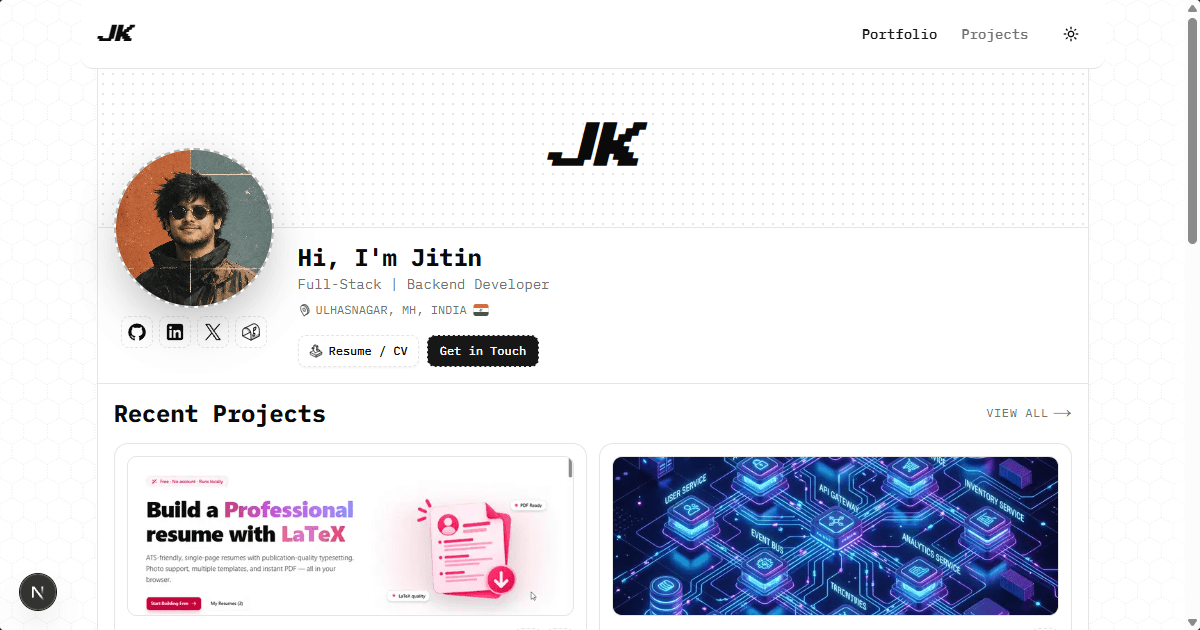
Portfolio inżyniera full-stack prezentujące mikroserwisy, systemy rozproszone oraz nowoczesny frontend.
Stworzenie wyjątkowego doświadczenia wizualnego z płynnymi animacjami i wysokimi wynikami Core Web Vitals.
| Technologia | Wersja | Cel | Dlaczego wybrano |
|---|---|---|---|
| Next.js | ^16.1.6 | App Router framework | Server Components, file-based routing, API routes, image optimization |
| React | ^19.2.4 | UI library | Server Components and concurrent rendering |
| TypeScript | ^5 | Type safety | Typed project content catches slug/data mismatches at compile time |
| Tailwind CSS | ^4 | Utility-first styling | CSS-first config with @theme/oklch tokens, no JS config file |
| Framer Motion | ^12 | Animations | Stagger/fade/hover primitives with useInView and useReducedMotion |
| @xyflow/react + dagre | ^12.11.5 / ^0.8.5 | Architecture diagrams | Data-driven interactive graphs with automatic layout |
| Nodemailer | ^7.0.11 | Contact email delivery | Simple Gmail SMTP transport from a single API route |
| @upstash/ratelimit + @vercel/kv | ^2.1.0 / ^3.0.0 | Distributed rate limiting | Shared sliding-window counter across serverless instances |
| Radix UI + shadcn/ui | primitives + copied source | Accessible UI primitives | Accessible tooltips/labels with full style control via copied components |
| Vercel | — | Hosting & analytics | Zero-config Next.js deploys, CDN, Web Analytics |
| Metoda | Trasa | Cel |
|---|---|---|
| POST | /api/contact | Validate contact form input, rate-limit by IP, send email via Gmail SMTP |
Decyzja: Store all project content as typed constants in lib/projects/*.ts joined by slug
Dlaczego: Type safety, zero runtime fetch cost, no database or CMS dependency
Korzyści: Compile-time checks, ships with bundle, server-renderable, free hosting footprint
Kompromisy: Content changes require code changes and redeployment
Decyzja: Detail pages and layout are server components; lists, diagrams, and forms are client components
Dlaczego: Minimize client JS while keeping interactive features
Korzyści: Smaller bundle, faster first paint, SEO-friendly detail pages
Kompromisy: Mental overhead of the serialization boundary
Decyzja: Configure theme via @theme directives in globals.css instead of tailwind.config.js
Dlaczego: Tailwind v4 removes the JS config in favor of CSS-native tokens
Korzyści: One file for design tokens, oklch dark/light variables, simpler setup
Kompromisy: Different from v3 muscle memory
Decyzja: Derive architecture diagrams from data (nodes/edges) with Dagre auto-layout
Dlaczego: Diagrams stay consistent with content and render interactively
Korzyści: No hand-drawn images, zoom/pan, themable, ER table nodes supported
Kompromisy: Client bundle cost on pages that render diagrams
Decyzja: Validate + HTML-escape inputs, then rate-limit via Upstash sliding window with in-memory fallback
Dlaczego: Serverless instances don't share memory; shared KV store gives consistent limits
Korzyści: XSS-safe output, 5 req/min/IP abuse protection, graceful degradation
Kompromisy: Requires KV env vars for full protection; no CSRF token yet
Decyzja: Send contact emails through an existing Gmail account
Dlaczego: Simplest delivery path for a personal portfolio with no backend infra
Korzyści: One route handler, no third-party email SaaS
Kompromisy: App password rotation, self-email only, SMTP rate limits